
Inventory management is the process of planning, controlling and counting stock on hand so that it accurately matches customer demand. This matters most in a tourism-driven economy such as Chiang Mai during the high season (November – February), when cash circulation and tourist numbers are at their peak for the year. Managing stock systematically solves two main problems at once: it prevents stockouts that cost you sales, and it prevents overstocking, which ties up cash, creates storage costs and directly affects your tax position at the end of the accounting period.
Why Inventory Management Matters So Much in Chiang Mai's High Season
Chiang Mai's business cycle is strongly tied to the tourist season (seasonal demand). In key commercial areas such as Nimmanhaemin Road, the Old City moat, Mae Rim, Hang Dong and Mon Cham, customer traffic and order volumes for restaurants, cafés, souvenir shops and local handicraft sellers jump by 300% to 500% compared with the low season.
Demand swings of this size create two management challenges:
- The risk of holding too little stock: products sell out too quickly, sales are lost to competitors and the brand loses credibility.
- The risk of holding too much stock: owners often overestimate sales and order large quantities in advance. When the festive period ends after February, liquidity stalls because cash is tied up in goods on the shelf, and products deteriorate, expire or go out of date.
From an accounting perspective, ending inventory is also a key variable in calculating cost of goods sold (COGS) under the formula COGS = opening inventory + net purchases - ending inventory. If the stock figure is wrong, book net profit is immediately off, creating the risk of filing an incorrect corporate income tax return.
5 Professional Tricks for High-Season Inventory Management: No Stockouts, No Sunk Cash
Managing a warehouse effectively depends on calculations based on statistics and real data. Here are 5 standard strategies that Chiang Mai business owners can put into practice right away:
1. Calculate Your Reorder Point and Safety Stock Clearly
Decisions to reorder stock should be based on the ROP figure so that new stock arrives before you run out. Calculate it in the following steps:
- Calculate safety stock: to absorb sales fluctuations and shipping delays during long holidays
Safety Stock = (maximum daily sales x longest lead time) - (average daily sales x average lead time) - Calculate the reorder point:
ROP = (average daily sales x normal lead time) + Safety Stock
A caution for Chiang Mai: during the New Year and Songkran festivals, logistics usually run 2-3 days slower than normal, so set your lead time to reflect reality.
2. Prioritize Products with ABC Analysis
Not every product earns the same return. Classifying products by the Pareto principle (80/20) helps you allocate budget and attention where it pays off:
- Group A (fast-moving & high value): products that generate 70% – 80% of total revenue but usually make up only 10% – 20% of all SKUs, such as signature coffee beans, premium gift sets and export-grade tea. Control this group tightly, count it every week and never let safety stock run out.
- Group B (medium velocity): products that generate 15% – 20% of sales and account for about 30% of SKUs, such as mid-sized home décor and popular processed snacks. Count them every 2 weeks to 1 month.
- Group C (slow-moving & low value): products that generate only 5% – 10% of total sales but account for as much as 50% of the product list, such as packaging, consumables and stickers. Use a minimum order quantity (MOQ) policy and do not overstock them.
3. Rotate Stock on a First-In, First-Out Basis (FIFO: First In, First Out)
Thai accounting standards (TAS 2 / TFRS for NPAEs) require inventory to be valued at a figure that reflects reality. FIFO suits products with a limited shelf life, such as coffee ingredients, milk, tea and processed foods.
- Arrange shelves so that older lots (with the nearer expiry date) are at the front and newer lots are stored at the back
- Label lot numbers and expiry dates clearly to reduce losses from writing off spoiled goods after the season ends
4. Carry Out Physical Counts Using Cycle Counting
Waiting for a single big count on the last day of the year usually means stock variances are found too late to trace. Switch to cycle counting, where smaller counts are done in weekly rounds:
- Spot-count Group A products every Monday, or once a week
- Count Group B products every 15 days
- Count Group C products once a month
If the difference between the system quantity and the physical quantity exceeds 1-2%, you can trace the cause immediately, such as a bill entered incorrectly, a staff member forgetting to deduct stock, or a loss.
5. Use a Point-of-Sale (POS) System to Deduct Stock Automatically in Real Time
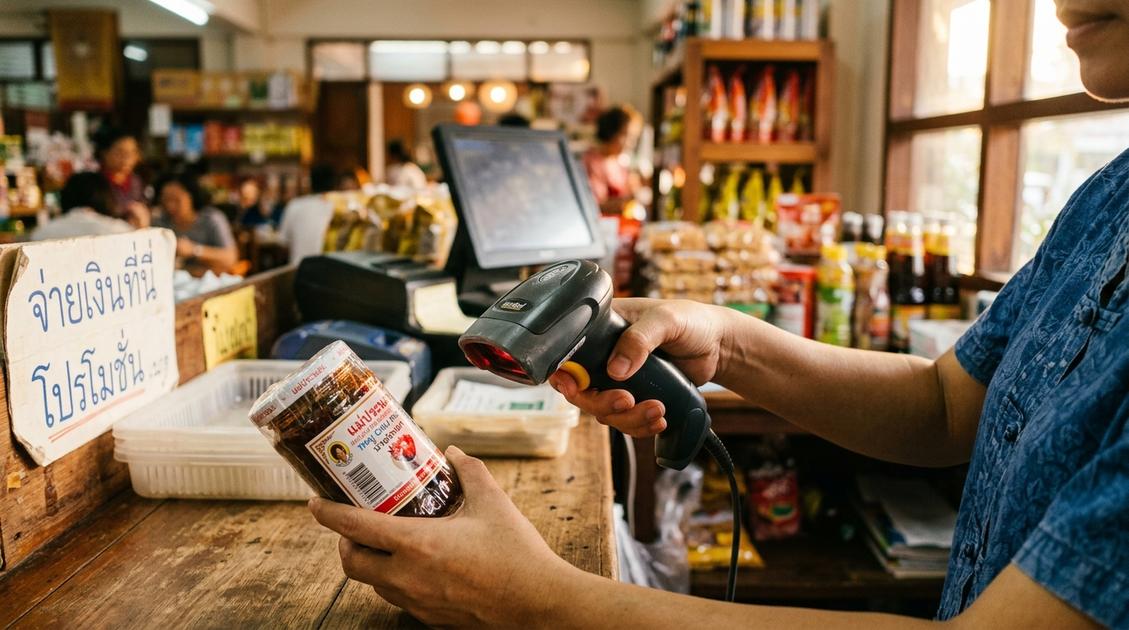
Recording stock by hand or in a logbook carries a high risk of human error. Linking the point-of-sale (POS) system to the inventory system deducts stock the moment a tax invoice or receipt is issued, alerts you when a product reaches its ROP, and prevents duplicate orders.
Worked Example: A Souvenir and Coffee Shop in the Nimman Area
Suppose the shop "Nimman Premium Craft" sells bagged specialty roasted coffee beans. During the December - January high season, its statistics are as follows:
- Average sales: 50 bags/day (peak sales on festival holidays: 80 bags/day)
- Normal lead time: 4 days (in case of festival shipping delays: 6 days)
- Product cost: 160 baht/bag (retail price 320 baht/bag)
Step 1: Calculate safety stock
Safety Stock = (80 bags x 6 days) - (50 bags x 4 days) = 480 - 200 = 280 bags
Step 2: Calculate the reorder point
ROP = (50 bags x 4 days) + 280 bags = 480 bags
Conclusion: when the coffee beans in stock fall to 480 bags, the shop must send a purchase order for the next lot immediately.
Comparing the impact on working capital:
If the owner orders on gut feeling and stocks up to 2,000 bags when real demand is 1,000 bags, there is a surplus of 1,000 bags, which means sunk cash of 1,000 x 160 = 160,000 baht. That money cannot be used for wages, marketing or a tax reserve.
Traditional vs Systematic Inventory Management Compared
| Comparison point | Traditional method (handwritten / estimated) | Systematic method (2026 accounting standard) |
|---|---|---|
| Accuracy of stock figures | Figures are often off; the real number is known only at the year-end count | Matches real-time sales; every bill can be traced back |
| Control of sunk capital | Orders based on gut feeling; high risk of sunk cash after the high season | Orders based on ROP and safety stock; liquidity stays stable |
| Readiness for a tax audit | No stock card report; risk of penalties and additional tax assessments | Complete and correct goods and raw materials report under Section 87 (3) |
| Handling lost / damaged goods | Cause cannot be found; cannot be written off as a tax expense | Destruction is documented per Revenue Department rules; correctly deductible as a tax expense |
Linking Stock to the Tax System: Guidance from the Chiang Mai Accounting Services Team
Inventory management is directly tied to the legal requirements of the Revenue Department. Juristic persons (companies) and VAT-registered operators must follow 3 key rules:
1. Keep a Goods and Raw Materials Report (Stock Card) under Section 87 (3)
A VAT-registered operator that sells goods must keep a "goods and raw materials report" and record each receipt or issue within 3 business days of the date the goods were received or issued, under Section 87 (3) of the Revenue Code.
Penalties: failing to keep the report, or keeping it incompletely, is a criminal offence under Section 90 (15) of the Revenue Code with a fine of up to 2,000 baht (or a fine of up to 10,000 baht under Section 90/3 (3) for not keeping the report at all), and the assessment officer has the power to assess additional tax and penalties.
2. Watch Out for Stock Shortages (Missing Goods Count as Sales)
Under Section 77/1 (8) (e) of the Revenue Code, goods found missing from the goods and raw materials report are deemed to have been sold. The business then has the following tax obligations:
- The value of the missing goods must be included in the VAT calculation at 7% of market price
- A penalty of 1 to 2 times the tax applies under Section 89
- A surcharge of 1.5% per month (or part of a month) of the tax due applies under Section 89/1 until payment is complete
3. Writing Off Damaged, Deteriorated or Expired Goods
Goods that spoil, expire or are damaged during high-season sales and are thrown away without following the legal procedure are treated as a non-deductible expense under Section 65 ter (3) of the Revenue Code and cannot be deducted when calculating corporate income tax.
The correct procedure under the Revenue Department's instruction (Por. 79/2541 and related regulations):
- Prepare a damaged goods report stating the product name, quantity, cause and cost
- Appoint a counting and destruction committee of at least 2 people
- Invite a certified public accountant (CPA), a tax auditor (TA) or an outside witness to observe the destruction
- Take photographs or video of the destruction as evidence attached to the count report
Working with an experienced Chiang Mai accounting services provider helps the shop reconcile front-of-store stock with the general ledger accurately and prepare supporting documents that comply with Revenue Department regulations.
Common Mistakes in Retail Stock Management
- Ordering more stock at the end of the season (the late-peak trap): December sales were very strong, so the owner doubles the order in late January, leaving goods unsold when tourists start to thin out in February-March
- Not separating in-store stock from online channels: using a single stock pool without real-time updates leads to duplicate orders, not enough goods to ship, and penalty points on marketplace platforms
- Not recording freebies, tasting samples and wastage: staff take products for tastings or in-store use without recording it, creating stock shortfalls and the risk of being assessed for output VAT
- Overlooking the hidden costs of holding stock (carrying costs): forgetting storage rent, deterioration, loan interest and electricity for cold rooms means selling prices do not reflect true costs
Frequently Asked Questions
If stock goes missing for an unknown reason, is tax payable?
Yes, tax is payable by law. Under Section 77/1 (8) (e) of the Revenue Code, goods counted at a quantity lower than the inventory report without clear evidence are deemed sold. The business must charge 7% VAT on the value of those goods and cannot deduct the cost of the missing goods as a tax expense, unless there is evidence of theft together with a police daily report.
Within how many days must the goods and raw materials report (stock card) be updated?
Section 87 (3) of the Revenue Code requires VAT-registered operators to record entries in the goods and raw materials report within 3 business days of the date goods are received or issued.
Does a café or restaurant in Chiang Mai have to keep a stock report for every item?
Finished goods bought for resale, such as bagged coffee beans, souvenirs or bottled drinks, require a full goods and raw materials report under the law. For fresh ingredients used to prepare food and drinks, keep a periodic control report of the main raw materials to support the cost of sales reconciliation in the accounts.
Can expired goods after the high season be thrown away and deducted as a tax expense immediately?
No. They cannot be deducted until the Revenue Department's procedure has been followed: a destruction approval document, photographic evidence, and a committee together with an auditor or witness who jointly counts and signs off on the destruction. Only then can the cost of the destroyed goods be recorded as an expense in the corporate income tax calculation.
Summary: Managing Stock for the High Season with Confidence
Effective inventory management during Chiang Mai's high season not only lets the business earn its full potential without running out of goods, but is also a key tool for protecting cash flow and reducing the risk of a retrospective tax assessment. Using a POS system to deduct stock automatically, together with a full-service accounting package, keeps the shop's documents, accounts and taxes correct and transparent.
If you own a business in Chiang Mai and want your accounting and tax systems set up correctly, contact YMTD Accounting Partner Chiang Mai. We handle monthly bookkeeping, tax filing and online digital document systems. You can consult our team conveniently via LINE.
Special offer! Customers who use YMTD's monthly accounting service receive a POS program for retail shops with stock management functions, worth 15,000 baht, free with the monthly accounting service. It works offline, keeps data securely on the shop's own device, has no monthly fee and no limit on the number of bills, and our team travels to install it and train you at your shop in Chiang Mai.
Interested in accounting and tax advice:
Tel: 081-542-3019
LINE: @premwittawat
Contact YMTD Accounting Partner Chiang Mai on any business day