
What Is Inventory Management Software and How Does It Work for Your Business?
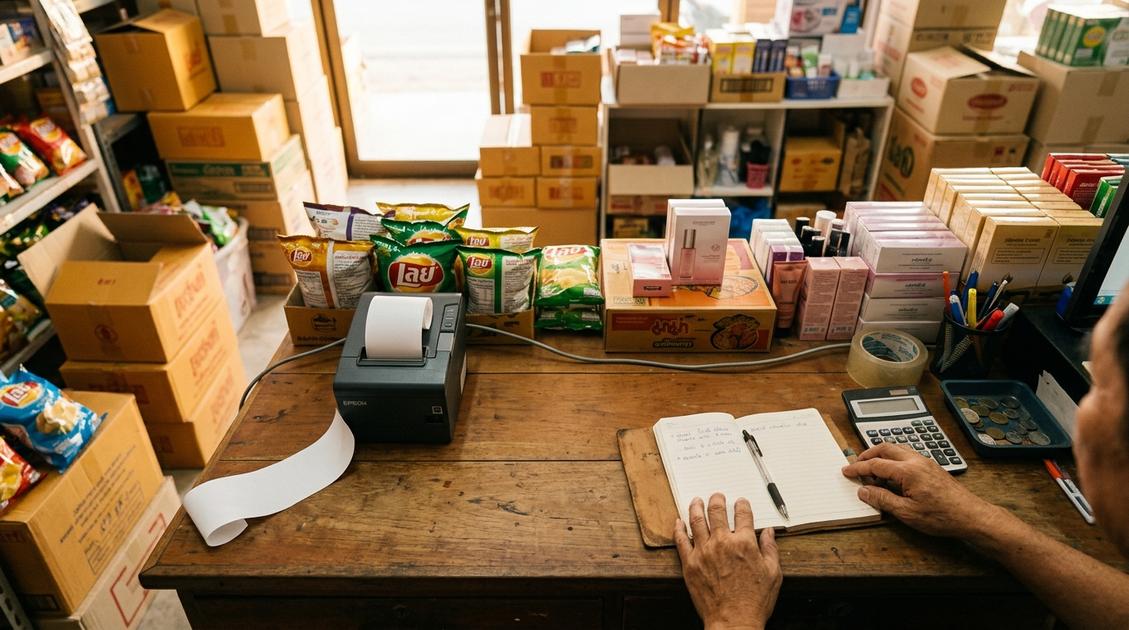
Inventory management software is software that controls and tracks the movement of inventory (Inventory Management System), connecting the workflow from goods receipt into the warehouse (Goods Receipt), through the issue of raw materials or finished goods via the point-of-sale (POS) system, to the automatic preparation of the goods and raw materials report (Stock Card). The system calculates balances and product costs using the first-in, first-out (FIFO) method or the weighted average cost method in accordance with Thai accounting standards.
The program's structure covers product code (SKU) management, units of measure, automatic reorder points, stock adjustment permission control, and the issue of receipt, transfer and stock deduction documents. This gives the business owner real-time visibility of stock balances, reduces losses and expired goods left in stock, and tangibly prevents cash being tied up in inventory.
Why Stock Control Decides a Shop's Profit and Tax
In accounting terms, "inventory is a current asset with a value equivalent to cash". If stock leaks, the cost of goods sold (COGS) figure in the financial statements is immediately wrong, which in turn affects net profit and the corporate income tax calculation.
Section 65 bis (6) of the Revenue Code requires inventory at the end of the accounting period to be valued at cost or market price, whichever is lower (lower of cost or market), and this becomes the opening inventory of the next accounting period. The accounting formula for cost of sales is (opening inventory + net purchases during the period - closing inventory). So if closing stock goes missing without supporting documents, the cost of sales will be overstated and the financial statements distorted.
In addition, under Section 87 (3) of the Revenue Code, a VAT-registered business must complete the "goods and raw materials report" within 3 working days of the date goods are received or issued. If an assessment officer from the Revenue Department carries out a physical stock count and finds that goods are short against the report, the law applies as follows:
- It is treated as a sale immediately under Section 77/1 (8) (e) of the Revenue Code; the value of the missing goods is subject to VAT (7%) at the market price on the date of discovery
- A penalty of 2 times the tax, calculated on the tax base of the goods short against the report, under Section 89 (10)
- A surcharge of 1.5% per month (or fraction of a month) of the unpaid tax under Section 89 bis, excluding the penalty
- A criminal fine of up to 2,000 baht per offence for failing to prepare the goods and raw materials report, or for incomplete entries within the period required by law
Worked Example: Missing Stock, the Hidden Cost a Café in the Nimman Area of Chiang Mai Faces
Case study: a café and bakery operating as a juristic person (company), VAT-registered, in the Nimmanhaemin area of Chiang Mai, with average sales of 300,000 baht per month. At the end of the 2026 financial year, a physical stock count found that coffee beans, imported syrups and souvenir products had gone missing without any damage write-off documents or evidence of loss, at a total cost of 180,000 baht (selling price assessed at market value: 240,000 baht).
Assessment of the tax burden and penalties the shop must bear:
- Cost of goods lost: 180,000 baht (capital genuinely gone)
- VAT (7%) on the amount the Revenue Department assesses as sales: 240,000 baht × 7% = 16,800 baht
- Penalty of 2 times (under Section 89): 16,800 baht × 2 = 33,600 baht
- Surcharge of 1.5% per month (assuming a period of 6 months): 16,800 baht × 1.5% × 6 months = 1,512 baht
- Corporate income tax on non-deductible expenses: the 180,000 baht of lost goods cannot be substantiated under the Revenue Department's criteria, so it is a non-deductible expense under Section 65 ter (13) and must be added back to net profit for corporate income tax (SME rate of 15% on net profit above 300,000 baht), an additional 27,000 baht of tax
Total damage: from 180,000 baht of missing stock, the business must bear tax, penalties and surcharges totalling 78,912 baht, a total financial loss of 258,912 baht. A stock system connected to the POS records write-offs immediately and prevents this problem from the outset.
Steps to Set Up a Stock System with an Accounting Service in Chiang Mai to Close the Leaks
Installing the software delivers the greatest benefit when it works alongside internal accounting controls. Setting up the system together with an expert accounting service in Chiang Mai involves 4 key steps:
1. Design the Product Code (SKU) Structure and Set Units of Measure to Match the Tax Invoices
Classify products clearly, separating finished goods, raw materials and supplies, and set standard units of measure that match the purchase and sales documents so that the inventory records meet the requirements of the goods and raw materials report.
2. Record Sales and Deduct Stock Through the Front-of-House POS System
Use barcode scanning to deduct stock in real time when payment is made, and record discounts and free items in the system, to prevent dishonest staff taking goods out of the shop without issuing a sales bill.
3. Set Up a Process for Destroying Damaged/Expired Goods Under Revenue Department Rules
Define a "damaged/lost/expired goods report" form with photographs as evidence, and follow Revenue Department Instruction No. Por 79/2541 when destroying goods (e.g. notify the area Revenue Office in writing at least 30 days before the destruction date, and have the auditor present as a witness), so that the write-off can be lawfully deducted as a tax expense.
4. Reconcile Physical Stock with the Monthly Accounting System (Stock Reconciliation)
Arrange weekly rotating spot counts (cycle counts) for high-value items, and reconcile the movement reports from the POS system against the purchase and sales journals and tax invoices, to find variances and correct the entries before the monthly financial statements are closed.
Stock Management Comparison Table: Traditional Method vs Inventory Management Software
| Comparison point | Manual records / general Excel | Inventory management software + POS |
|---|---|---|
| Stock deduction accuracy | Low; risk of forgetting to record or keying in errors | High; deducts automatically by barcode the moment a sale is made |
| Fraud control | Hard to check; no log of who edited the data | Log system records the history of stock adjustments and approval rights |
| Preparing Revenue Department tax reports | Time-consuming; risk of missing the 3-working-day deadline | Pulls the goods and raw materials report in the prescribed Sor.Kor. form instantly |
| Reconciliation with the accounting system | Data must be re-entered; documents easily go missing | Sends sales and cost data directly into the accounting system |
| Time-cost efficiency | Time lost counting and chasing year-end stock differences | Checks balances in real time; plans purchasing accurately |
4 Common Stock Mistakes That Invite a Revenue Department Audit
The stock management mistakes commonly found in small and medium-sized businesses, which are the risk points the Revenue Department uses for retroactive tax assessments, are:
- 1. Writing off damaged or expired goods without following Instruction Por 79/2541: disposing of expired or spoiled goods without a destruction record, without photographs, and without an outside party/auditor as a witness. The Revenue Department will not allow the write-off as a cost or expense, and treats the missing goods as a sale subject to 7% VAT plus penalties
- 2. Counting stock only once a year at the end of the accounting period: without cycle counts, you cannot tell when the stock started leaking, so you cannot trace who was responsible or produce evidence in time
- 3. Negative inventory in the system: caused by issuing sales bills before the goods receipt document has been recorded. From the Revenue Department's point of view, negative stock indicates that goods were bought and sold off the books without the purchase tax invoices being submitted
- 4. Inflated stock in the financial statements (ghost inventory): caused by purchasing goods without correctly recording the cost of goods sold, so the inventory figure on the balance sheet is overstated. Accounting profit is then overstated and the business pays more corporate income tax than it should
How to Choose Inventory Management Software That Is Worth the Money and Fits Your Business [2026]
To choose inventory management software that serves both front-of-house operations and accounting, consider these 4 main criteria:
1. Supports Offline Operation (Offline Mode)
The front-of-house POS system must be able to record sales and deduct stock on the device immediately while offline, keeping the database securely on the device, so there is no worry about the shop floor grinding to a halt when the internet goes down.
2. Links Fully with the Accounting and Tax Systems
The program must be able to export sales, cost of sales and inventory reports in a format that connects to a full-service accounting service through leading cloud accounting software, reducing duplicate entries in the daily journals.
3. Has a Data Access Permission System (Role-Based Access Control)
It should be possible to restrict front-of-house staff to scanning sales and viewing stock quantities only, with no rights to adjust product quantities (stock adjustment) or edit product costs, to prevent fraudulent changes to stock figures.
4. Value for Money and a Transparent Price Structure
Calculate the cost of the software, hardware and annual service fees carefully. Business owners can also opt for cost-effective solutions, such as the right to use the front-of-house POS and stock management program worth 15,000 baht (free with the monthly accounting service), to reduce the upfront cost of setting up the business's system.
Frequently Asked Questions About Inventory Management Software
1. If goods go missing from the shop without being recorded in the accounts, what is the penalty if the Revenue Department finds out?
Under Section 77/1 (8) (e) of the Revenue Code, the Revenue Department treats goods short against the report as a sale. The business must pay 7% VAT on the market price of the missing goods, plus a penalty of 2 times under Section 89 (10) and a surcharge of 1.5% per month under Section 89 bis. In addition, the cost of the lost goods cannot be deducted as a tax expense unless there is evidence of a police report in a case of theft.
2. Within how many days must the goods and raw materials report under Section 87 (3) be recorded, and what must it cover?
A VAT-registered business must record receipts and issues in the goods and raw materials report within 3 working days of the date the goods are received or issued. The report must state the product name, product code, quantity received, quantity issued and quantity remaining in full. Failure to prepare it carries a criminal fine of up to 2,000 baht per offence.
3. How must expired or spoiled goods be destroyed for the Revenue Department to accept them as a tax expense?
You must follow Revenue Department Instruction No. Por 79/2541: notify the area Revenue Office in writing of the destruction at least 30 days before the destruction date, appoint a committee to count and destroy the goods, have a certified public accountant (CPA) or an outside party present as a witness, and take photographs/video of the destruction process as evidence to support the write-off in the accounts.
4. How does a cycle count differ from an annual stock count?
A cycle count is a spot count of certain product groups or fast-moving items every week or month without closing the shop, so leaks or errors are detected immediately. It differs from the annual physical count, which is done only once a year at the end of the accounting period; if a difference is found at year end, the source of the loss cannot be traced.
Summary: Managing Stock Safely for Steady Growth
Investing in a system and choosing inventory management software that connects to the POS system and accounting standards does not only prevent lost goods and control costs accurately; it is also the foundation for keeping the accounts and planning business taxes correctly, reducing the risk of retroactive tax assessments, penalties and surcharges.
For business owners who want their front-of-house stock system seamlessly linked to their accounting, contact YMTD Accounting Partner in Chiang Mai. We are ready to advise and look after your accounting and tax work closely.
Consult our professional team:
Tel: 081-542-3019
LINE Official: @premwittawat